
 简体中文
简体中文 English
Project Overview
[Client Location] Jiangsu
[Project Conditions] Dust control for manual welding in a shipbuilding workshop
[Control Method] Dual-layer control: “local + overall”
[Equipment Used]
Local: High-negative-pressure dust collection system
Overall: HXHJ-XF12 series + large-scale fume hood
Over the past decade, China’s shipbuilding industry has seen a significant increase in its global market share, making China one of the world’s major shipbuilding hubs. With the rapid development of China’s shipbuilding sector, enterprises have rapidly enhanced their capabilities and expanded production scales. During ship construction and repair, various operations such as welding, cutting, grinding, sandblasting, and painting are carried out throughout the entire production process, generating substantial amounts of smoke and particulate pollutants that not only contaminate the atmospheric environment but also pose serious health risks to workers.
Welding is one of the primary processes in shipbuilding. The electric arc welding fumes produced contain metals such as manganese, iron, aluminum, zinc, copper, and their oxides, which can cause a variety of respiratory diseases. Long-term, heavy inhalation by welders may lead to occupational pneumoconiosis. Welding plays a central role in stages like component assembly and welding, flat and curved surface segment assembly, and dock closure. Workstations such as welding lines, CO2 shielded welding, and manual stick welding are densely distributed, generating large volumes of welding fumes—especially inside ship hull compartments, where fume concentrations can exceed 100 mg/m³.
Client Conditions and Requirements
1. Existing service doors (equipped with standalone welding machines) require integrated dust control; since the welding workshop is located beneath the service door frame, it is necessary to address the issue of diffused fumes during welding operations.
2. The workshop handles large workpieces and numerous manual welding stations, resulting in severe health hazards for workers and environmental pollution, while also adversely affecting the quality of fabricated components.
3. In accordance with national environmental protection regulations, welding fumes must be purified before discharge and meet prescribed emission standards.
Solution
Project Challenges | Solutions |
Ensuring the workshop’s air quality without interfering with the normal operation of welding equipment beneath the service door frame | Jinan Huaxin Automation, based on on-site working conditions, implemented simultaneous local and overall dust collection. A large overhead suction hood was installed above the service door frame—a pioneering approach nationwide.
|
Sturdiness of the fume hood, load-bearing capacity of the service door frame, and reliability of fume capture | The hood design employs purlins and truss structures, using lightweight aluminum alloy instead of carbon steel to ensure structural integrity while reducing the load on the service door frame. A soft windproof curtain is suspended around the perimeter of the fume hood to prevent crosswinds from dispersing the collected fumes. |
Local fume capture | Considering the size and shape of welded workpieces as well as the operational positions involved in welding, a vacuum hood was installed at the welding torch tip, moving along with the torch to collect fumes. A high-negative-pressure dust collector was then used to purify and discharge the captured fumes. |
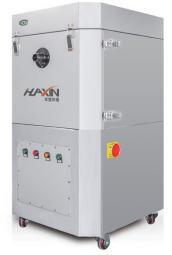
HXHJ-GD1000
Processing airflow: 1,200 m³/h
Power: 18.5 kW
Handling escaped fumes | A portion of escaped fumes is collected and treated by a low-negative-pressure dust collection system, while the remaining fumes are trapped and captured by the fume hood. Our independently developed HXHJ-XF12 model is employed for further purification. |
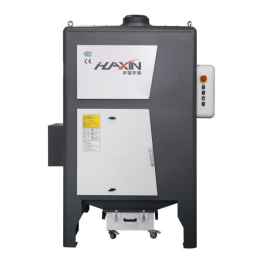
HXHJ-XF12
Processing airflow: 12,000–15,000 m³/h
Power: 15 kW
Project Outcomes
1. Fume collection efficiency: The high-negative-pressure dust collection system achieves a local fume capture rate exceeding 90%, while the remaining escaped fumes are dynamically captured by the centralized collection system, effectively eliminating visual pollution at the work site.
2. Fume filtration efficiency: The HXHJ-XF series dust collectors boast a filtration efficiency of 99.99%, ensuring effective removal of particulates before discharge.
3. Air emission concentration: After passing through the dust collector, particulate emissions are reduced to below 10 mg/m³, meeting national emission standards.
4. Space utilization: The overall layout is optimized, satisfying the service door frame’s operational requirements without disrupting normal workshop activities.
About Us
Jinan Huaxin Automation is a nationally recognized high-tech enterprise specializing in intelligent manufacturing and automation solutions, dedicated to driving the transformation and upgrading of high-end manufacturing. As a leading domestic provider of process gas systems and exhaust gas treatment solutions, the company relies on self-developed smart equipment and advanced technologies to deliver robust technical support. We focus on high-standard, diversified manufacturing scenarios, emphasizing the fulfillment of specific operational needs, offering tailored, comprehensive smart transformation packages, and providing end-to-end services—from demand analysis and system design to equipment installation and post‑maintenance. Jinan Huaxin Automation will continue to advance the digitalization and intelligentization of manufacturing, helping enterprises stand out in fierce market competition and achieve sustainable growth.